

Frequently Asked Questions about motorcycle tyres
We strongly advise against this. Bridgestone motorcycle tyres are developed to give the best combined performance between front and rear tyres. We therefore recommend that you use a single type for your motorbike.
The best maintenance for a tyre, is a correct tyre pressure. Remember also to never use protectants, cleaners or silicone based sprays to enhance your tyre appearance.
Getting your tyre up to a good operational temperature depends on a number of things. Bridgestone tyres are known to have a relative short time to warm up. Nevertheless, other factors come in play. The temperature of the road, the components used in the tyre, your riding style and atmospheric conditions are important. As a rule of thumb, braking and accelerating will help warm up a tyre faster than doing zig-zag movements. On a normal day, gradually increase accelerating and braking during the first 10 minutes and you’ll be fine!
As a rule of thumb, you need to use an inner tube if your tyre is marked as ‘tube type’ or if your wheel is a tube type. However; there are exceptions to the rule. Bridgestone uses a UM letter code to define tyres with a marking ‘Tubeless, use tube on a tube type rim’. This means the tyre is developed as a tubeless tyre within rim standards for a tubeless rim. But this tyre can still be used on a tube type rim, using an inner tube. These tyres have been tested and validated regarding inner liner friction and bead setting.
Tyres have a four-digit number stamped on the sidewalls indicating the week and year they were manufactured and this is useful information, especially if you are buying a used bike. Tyre condition can deteriorate with age. Main factors are change in temperature, UV rays and humidity.
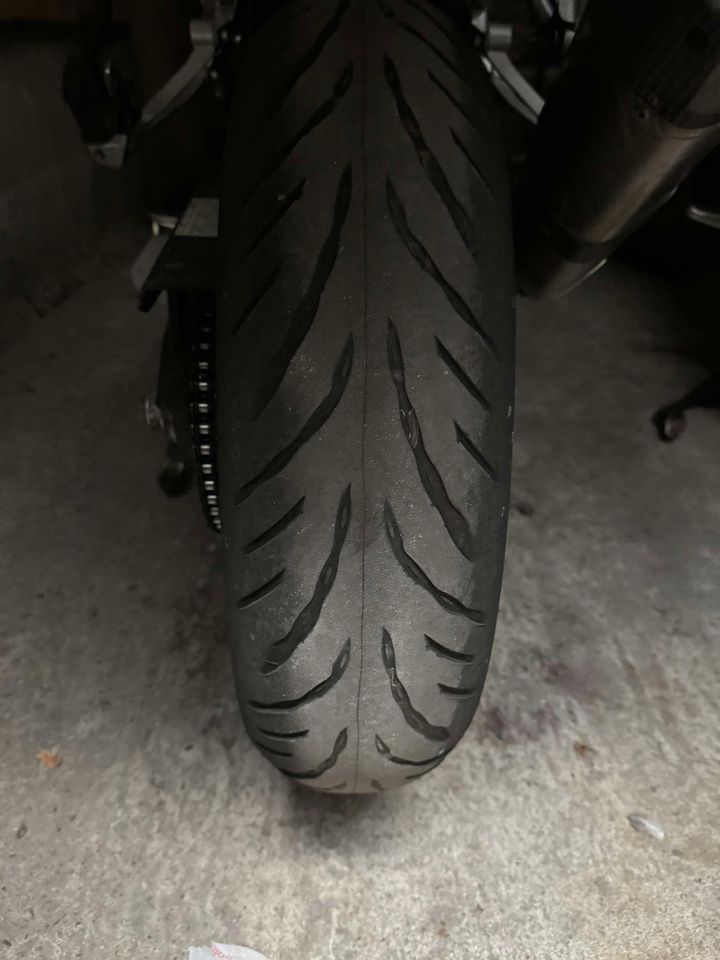 No, this is not a defect. The stripe is known as the antenna compound, a special rubber element designed to discharge static electricity by conducting it from the tyre to the asphalt. It is a normal and intentional feature of the tyre’s design.
When you buy a new motorcycle, the tyres it comes on ex-factory might have the same pattern name and design as the ones you could buy from a motorcycle tyre retailer. But when you take a closer look you might notice in some cases that there is an extra letter in the pattern name (eg. S22F E).
This additional letter indicates that it is what we call a “spec tyre”. This means that this specific version of our tyre has been slightly tuned to fit the specific needs or character of the motorcycle its mounted on, at the request of the motorcycle manufacturer. This could be to better deal with the weight of this motorcycle model, high speed stability, chassis construction, …
It’s important to note that this spec tyre will only have the desired effect on the motorcycle model it has been tuned to. So if your motorcycle is equipped with a spec tyre, you can replace them with the same spec tyres or with the standard replacement tyre (in this case: S22F – “F” stands for “Front”) when the tyres are worn out. The choice is yours, but know that the priorities for a motorcycle manufacturer can differ from those of the rider, so the tyres might behave differently than you expect. Bridgestone’s standard replacement tyres are always developed to meet the rider’s needs on an overall performance level.
However, don’t use a spec tyre designed/tuned for Bike A on another bike. In that case, or whenever in doubt, use the standard replacement tyre which was developed for a wide range of usages and bikes.
Your local tyre dealer can assist you in making the correct choice, and can also advise you on possible local legislations regarding the usage of certain tyres on your bike.
The average life and mileage expectancy are heavily dependent on the vehicle and the conditions of use. We recommend taking into account seven factors affecting the durability of a tyre:
- The inflation pressure
- The load that is being transported
- The speed of the vehicle
- The riding style (braking and acceleration)
- The type of surface
- The air temperature
- The twistiness of the road
The recommended tyre pressure is set by the manufacturer of your motorcycle. You can find the information in the manual or a sticker on the bike itself (often on the swingarm). If you don’t have the manual, these can often be found on the internet and, if all else fails, an official dealer will be able to help.
For tyre pressure on track, see this link/click here.
We recommend removing the tyres before they reach the treadwear indicator bars. This can vary from 1mm to 1,6mm depending on local regulations.
Worn/unworn tyre combinations and worn tyres used in wet conditions can result in deteriorated handling.
To find a retailer near you, we recommend to use Bridgestone’s ‘where to buy’ tool: click here.
Find a dealer near you, in just a few clicks.
To find the right tyre and the best recommendation, we advise you to use the Bridgestone tyre catalogue. You can access the catalogue via this link.