

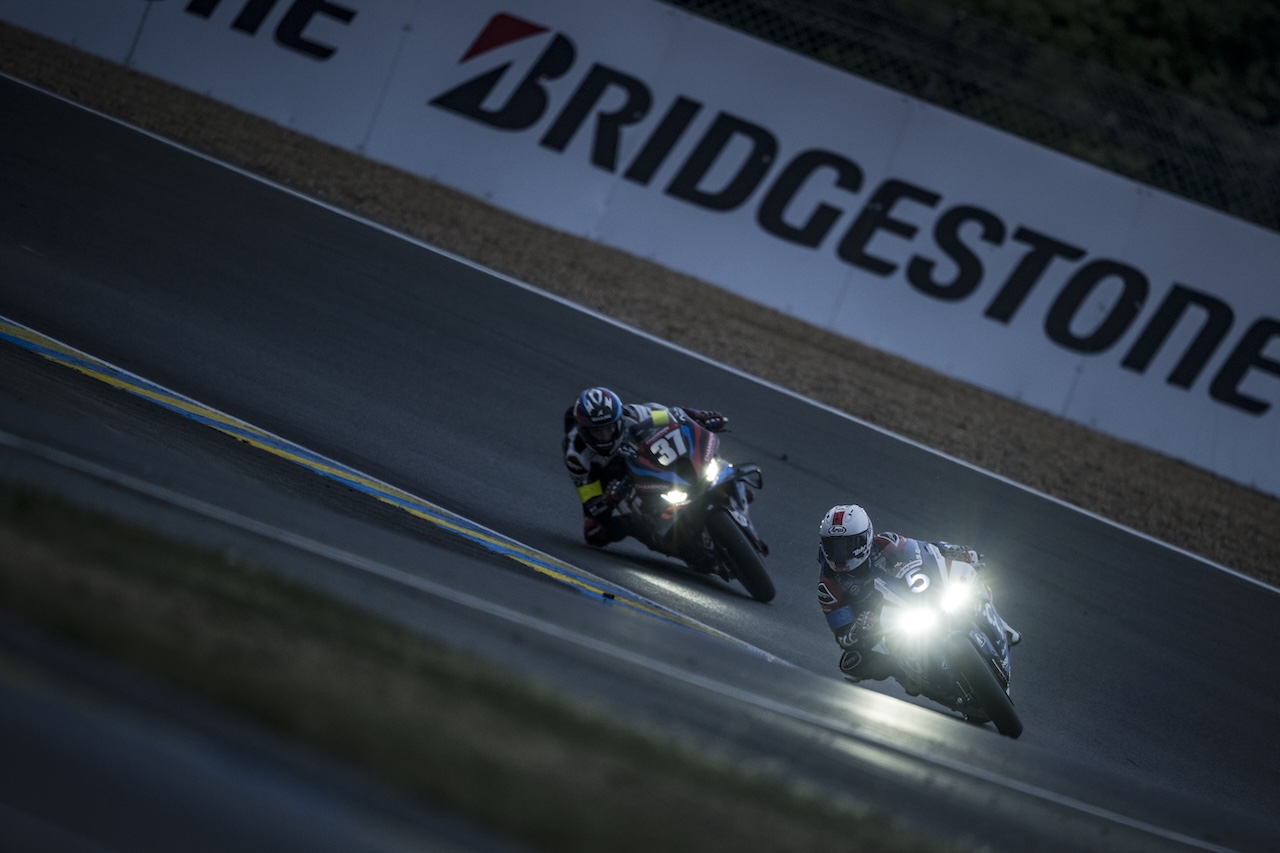
Bridgestone in the Endurance World Championship – Life of a Tyre
Top teams
Tyres for dry conditions in the Endurance World Championship are always slicks, tyres without a tread pattern to provide optimum grip on a dry track. Bridgestone started their engagement in the EWC in 2016, and there is no doubt that these are the best tyres in the championship. With BMW Motorrad World Endurance now also opting for Bridgestone tyres, five top teams now ride on Bridgestone tyres. That says a lot.
Everything Bridgestone learns from the performance will also be transferred to the production of tyres that everyone can buy. Bridgestone makes this an absolute matter of honor. An EWC tyre is, on the one hand, the result of years of research and development. At the same time, it is also a research tool with the aim of making ever better tyres.
Gripping Stories traveled to the 24 Hours of Le Mans to learn more about the life of a racing tyre.

Eye for detail
Bridgestone has become a master at predicting what will be needed during a particular race. This involves taking into account the asphalt, but also the temperatures, weather conditions, tyre pressure, the temperature of the tyre warmers, and even the character of the different motorcycles. For example, we know that the Kawasaki of the Webike Trickstar Team—also riding on Bridgestone for the first time this year—has a very aggressive engine character. This places slightly different demands on a tyre than, for example, the YART Yamaha, which transfers its power to the rear tyre in a less aggressive manner. The electronics of each motorcycle also play a role, and then of course there are the riders. Everything is taken into account, and when you ask the new teams, BMW and Kawasaki, what makes working with Bridgestone so special, the answer is: attention to detail.

Type
What makes the carcass and rubber compound so special is… a secret. As the competition is watching closely, these details can’t be shared. People talk about ‘rubber’, but rubber is only a small part of the chemical mix that falls under the heading ‘rubber’. That is why an EWC tyre does not really have a name. Although the name Bridgestone gives to the tyres is often the same in each individual race, the type of tyre that falls under that name is completely different from race to race and from circuit to circuit. Even the teams do not know which type of tyre is behind which name.

Sympathy
So when a tyre is taken out of the mold in Tokyo, it’s always with a specific race in mind. In this case: Le Mans and, for example, the BMW M 1000 RR. The tyre is then transported to the track, together with around 1,300 of its counterparts. This is done with the utmost care. The slick will always be stored upright between other tyres in heated containers. This costs a fortune, but it ensures that the carcass does not get creased or crushed under a pile of other tyres, let alone that the compound breaks down due to the cold.

Instructions
Once on site, the choice of tyres is determined by the group of Bridgestone engineers. A selection of three slick rear tyres is common. Let’s simply call them soft, medium, and hard. Each team has a designated engineer, with an overarching team of engineers above them. They determine which tyre is used when and also give instructions in the pits about warming up, how long a tyre needs to warm up, and so on. A Bridgestone tyre is therefore treated with the utmost care. When mounting the tyres on the rims, which is done by a team of about 10 mechanics, great care is taken to ensure that the slick fits perfectly on the rim. An indicator line on the sidewall makes it possible to check this.
Nut
Bridgestone’s engineers are also very specific about the types of valves used. Details can play a huge role. Later in the race, the front tyre on the winning YART Yamaha will deflate in the early morning. Simply because a nut securing the tyre valve has failed. A tiny part, but one with potentially huge consequences.

Wide range
At Le Mans, it is cool and damp. But the ‘super soft’ compound means that the Bridgestone slicks can handle it. Another thing the teams have noticed this year is that the Bridgestones work well in a very wide range of conditions. The competition is more sensitive to changing weather factors such as temperature or humidity and therefore has to fit a specific tyre for specific conditions more often. The Bridgestones hold up better across a wider spectrum.
This is something that naturally translates very well to the tyres you use on your motorcycle. Versatility is an invaluable advantage in both everyday life and endurance racing. In these increasingly exciting races, every pit stop is half a lap or a whole lap that you can hardly make up on the track. And on public roads, any unexpected change in grip level or conditions is something that tyres with a wide performance range naturally make safer.

Info
We can’t share any exact information about temperatures, tyre pressure, and lean angles here, as that is confidential information between Bridgestone and the team. Even the other Bridgestone teams are not allowed to share that information with each other. The fact that BMW returns to the pits after 32 laps – and then only because it has run out of fuel – in fourth place, behind YART-YAMAHA, Kawasaki Webike Trickstar, and F.C.C. TSR Honda France (all also on Bridgestones) perhaps says more about the performance of the tyres than any other information.

And afterwards?
When the tyres are changed in a flash during the pit stop, the team immediately rolls away the used slicks for a quick check. Temperature, tyre pressure, and a visual check of the tread. Nothing to complain about. It is the rider who receives applause from the team, but the tyre played a major role in this success.
Because this slick performed so well in unusual circumstances, the barcode is scanned. This means that this tyre will be kept separate and thoroughly examined afterwards, and the data stored. How much of the tread has worn away? The tyre will be thoroughly photographed, then stored in Germany and finally flown back to Japan for really in-depth research.

Bridgestone DNA
The most important part of this story is the end customer. Yes, you, who now know that the next Bridgestone tyre you put on your motorcycle will also carry a wealth of experience from the toughest World Championship in the world. This is the Bridgestone DNA.